Evening at the harbor mouth
The breakwall, a west wind, and the twenty minutes after sunset when the lake turns the color of slate and Chicago appears on the horizon.
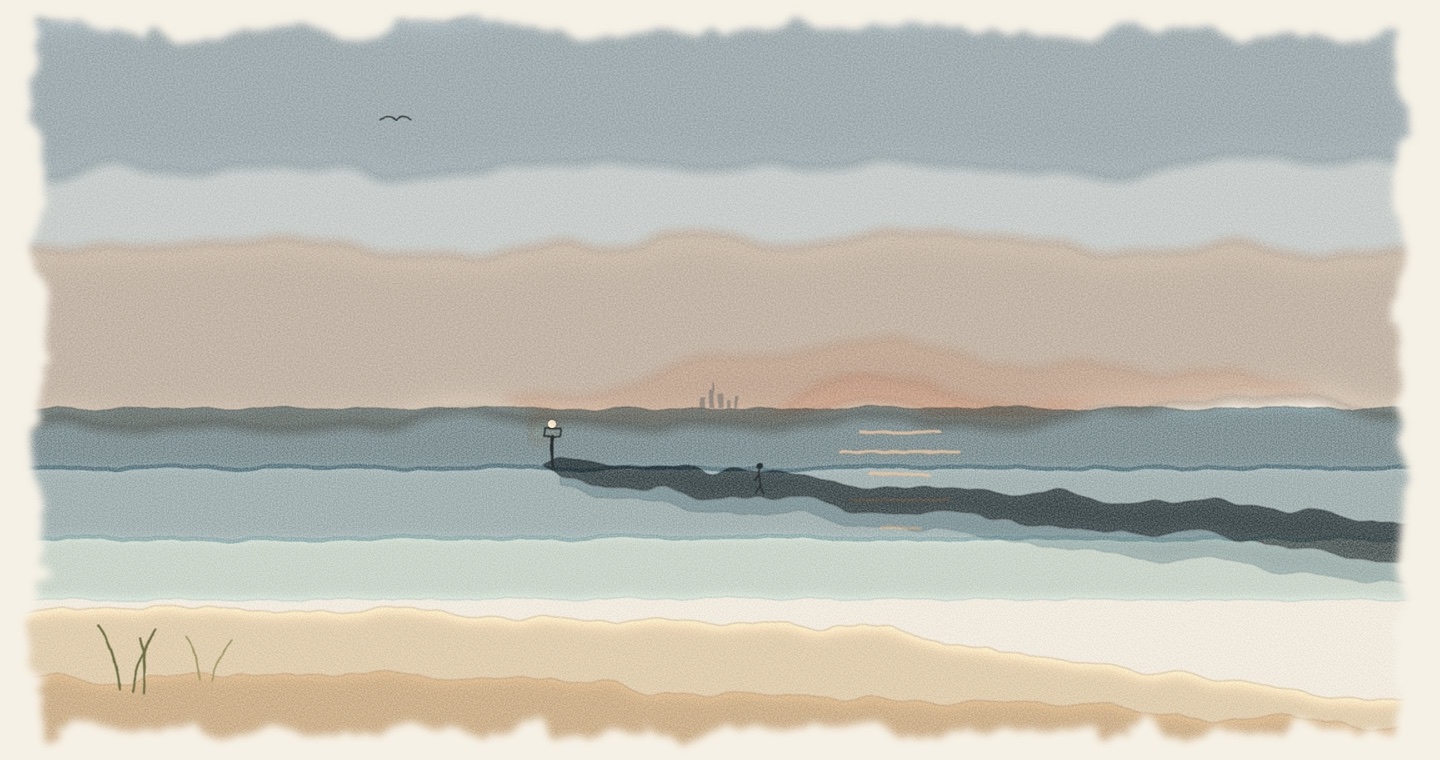
The harbor at New Buffalo is where the Galien River gives up and joins the lake. It comes out between two breakwalls of stone that the Army Corps of Engineers built after Congress authorized the harbor in 1962 — one about thirteen hundred feet long, the other a little over seven hundred — with a dredged channel between them for the boats.1 At the end of each wall there is a small navigation light. Neither is a lighthouse. The town’s lighthouse went up in 1840, was dark by 1859 and is long gone; the white tower you see on the north side of the river mouth is a replica, and not, the lighthouse historians will tell you, a faithful one.2
We come out in the evening when there is a west wind. A west wind on this coast has come across forty-odd miles of open water with nothing to stop it, and it arrives at the breakwall still carrying the lake: the waves stand up against the stone and fall back, and on a cool night the spray reaches the path. You can smell the water, which is the smell of a very large amount of fresh water — which is to say, of almost nothing, and cold.
The sun goes down. This is the part people come for, and they are right to; it is a good sunset, low and wide, and in high summer it lands well to the right of the city, over open lake. Then most of them leave, which is the mistake.
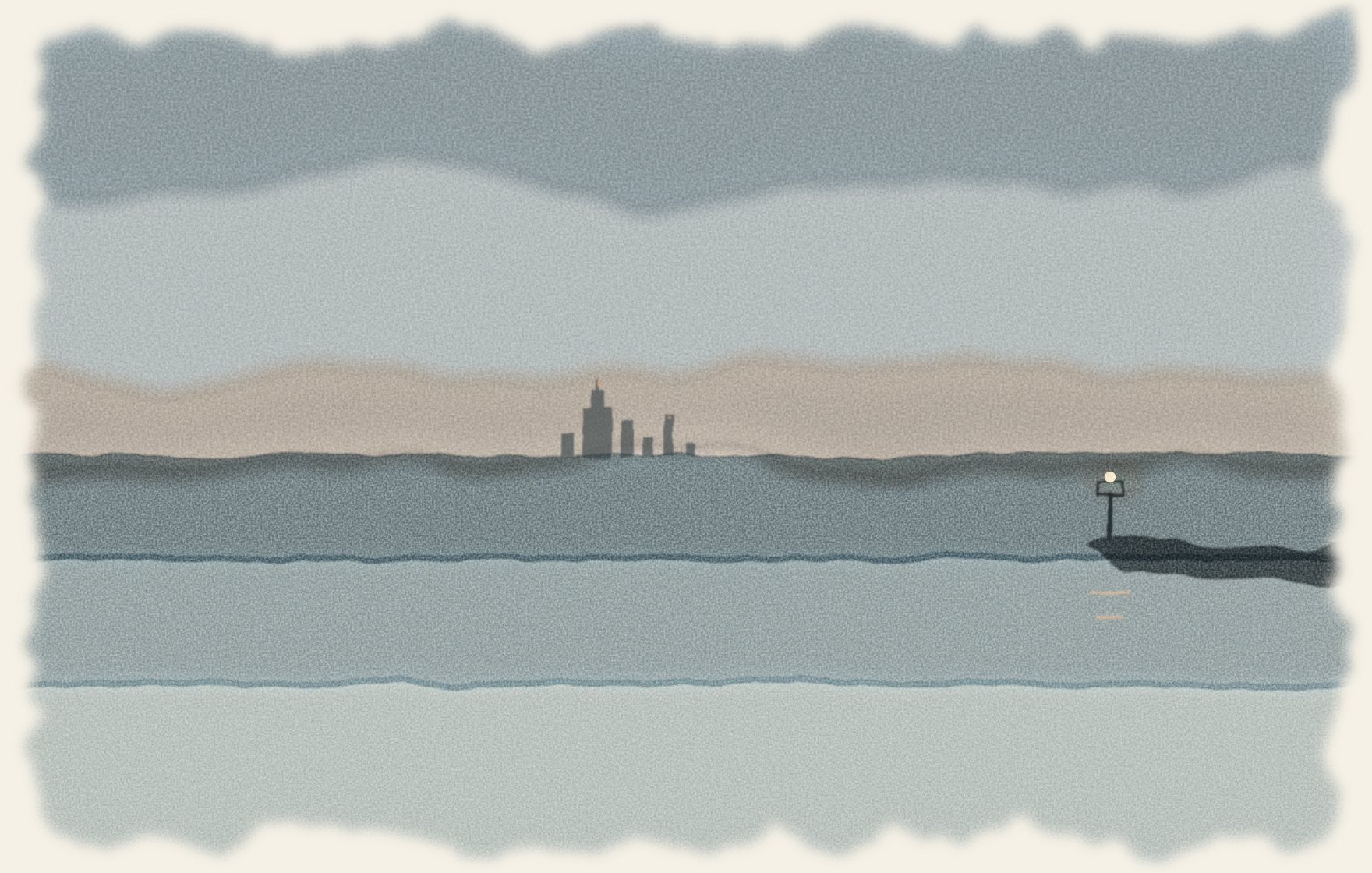
Stay for the next twenty minutes. The color goes out of the sky from the top down, as if someone were draining it, and the lake, which a moment ago was full of reflected orange, turns the color of slate, and then of wet slate. On the clearest evenings, Chicago rises out of the water — a faint line of towers across the lake that only makes this place feel further away.
It is a trick of geometry more than of light. From the end of the breakwall to Willis Tower is about forty-six miles, a few degrees north of due west. At that distance the curve of the earth hides roughly the first thousand feet of the city.3 What you see, when you see anything, is the top few hundred feet of the tallest towers: a handful of shapes standing at the water’s edge like pieces left on a board. Once the sun is below the horizon and the sky behind them is still bright, they come up as silhouettes, which is why the twenty minutes after sunset are better than the twenty before.
Some evenings — more often in April, when the lake is still cold and the air over it has turned warm — the atmosphere bends the light enough to lift more of the city into view, or to stack a second, inverted skyline on top of the first. Scientists call it a superior mirage. People on this shore mostly call their friends.4 In early April, and again in early September, the sun sets almost exactly behind the city.3 It takes the right evening and the right air, and the two don’t often coincide. That is not a reason to stop coming out.
Most evenings, of course, there is nothing there: haze, or cloud, or the plain fact of distance. Carl Sandburg, who lived a few miles up the shore in Harbert for seventeen years, wrote the lines for those evenings:
The fog comes
on little cat feet.
It sits looking
over harbor and city
on silent haunches
and then moves on.
That was in Chicago Poems, in 1916, a dozen years before he moved here, and the harbor he had in mind was presumably Chicago’s.5 But from this breakwall the lines work the other way round: the harbor here, the city over there, and the fog sitting on the lake between them.
There is a kinship across that water that is easy to forget from either side. In the summer of 2019 a pair of piping plovers — an endangered Great Lakes shorebird, small and sand-colored, with a dark band across the breast — nested on Montrose Beach, on Chicago’s North Side, the first plovers to nest in the city since 1955. Chicago took them to heart. Birders named them Monty and Rose, volunteers took turns watching the nest, and a music festival planned for the beach was called off.6 The same birds need the same things on this side of the lake: open beach in early summer, and people who give them room. The Great Lakes population, down to about a dozen pairs around 1990, has lately been counted at eighty or ninety. The recovery is real, and small, and depends on people behaving well on beaches like this one.
Then most of them leave, which is the mistake.
The beach itself is partly the harbor’s doing. The river brings sand down and the lake pushes sand along the shore, and the channel fills; when the Corps dredges it, the sand goes back onto the beach rather than out to deep water.7 And the beach, in Michigan, is more public than visitors tend to assume. In 2005 the state Supreme Court held, in Glass v. Goeckel, that anyone may walk the Great Lakes shore below the ordinary high-water mark, whoever owns the land behind it.8 The right is to walk, not to set up camp in front of someone’s cottage. But it means the whole long edge of the lake is, in the way that matters most, a footpath, and that you can start one here and keep going.
By the time we turn back, the light at the end of the wall is the brightest thing in view, and the towers have gone — not because they have faded, but because the sky behind them has caught up and is now as dark as they are. The wind drops, the way it often does after sunset. Walking back along the wall toward the town, you can hear the river again, going the other way.
Notes and sources
- U.S. Army Corps of Engineers, New Buffalo Harbor, Michigan (breakwaters of 1,305 and 740 feet; authorized 1962).
- Lighthousefriends: New Buffalo; U.S. Lighthouse Society, New Buffalo.
- Our calculation: great-circle distance from the harbor mouth (41.80° N, 86.75° W) to Willis Tower, 46 miles on a bearing of 277°; hidden height from an eye 6 feet above the water with standard refraction, about 1,000–1,070 feet; sunset azimuth at this latitude matches that bearing around April 3 and September 8.
- PBS NOVA, “The perfectly scientific explanation for why Chicago appeared upside down in Michigan”; MLive, “Superior mirages over Chicago” (2017).
- Carl Sandburg, “Fog,” Chicago Poems (Henry Holt, 1916). Public domain.
- Audubon, “Piping plovers nest in Chicago for the first time in over half a century”; Chicago Sun-Times, “Against all odds, piping plovers keep making history in Illinois” (2024); Monty and Rose.
- U.S. Army Corps of Engineers, New Buffalo Harbor fact sheet.
- Glass v. Goeckel, 473 Mich. 667 (2005), opinion; Michigan League of Conservation Voters, Beach walking on the Great Lakes shoreline.
Where we stay.
These evenings start from a house we keep in New Buffalo, [DISTANCE] from the harbor. It is open to guests for part of each year.
See the house