The coast in February
Shelf ice, empty roads, a wood fire, and the case for coming to a summer town in the one season nobody recommends.
By February the summer town has given most of itself back. The rental signs are in, the beach lots are empty or unplowed, and Red Arrow Highway, which in July moves at the pace of a farm stand, runs quiet between the villages. The light comes in low from the south all day and leaves early. The lake, which for four months was the whole point, has turned into a grey, heavy, faintly menacing presence at the end of every street. It is, by general agreement, the wrong time to come.
We would like to make the case for it. Not the whole case — some of February on this coast is simply cold, and we won’t pretend otherwise — but the case that the one season nobody recommends is the one in which the place is most itself.
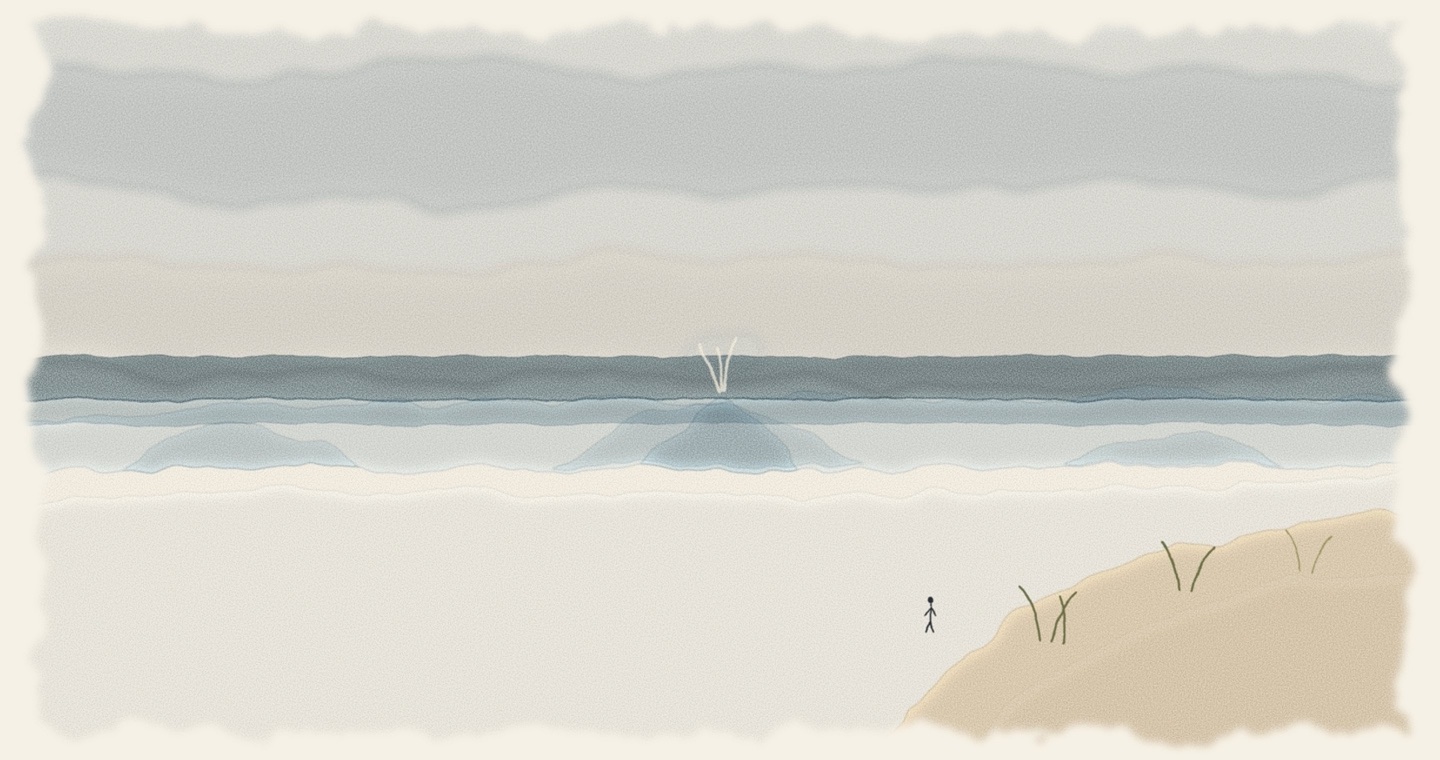
Start at the beach, because in hard cold the lake does something it does at no other time. When the air stays well below freezing for days, the waves and the spray they throw start to freeze at the water’s edge, and the ice builds outward from the beach in ridges, humps and caverns — shelf ice, the lake making a new coastline out of itself. It is white where it is new, blue-grey in its hollows, and in the right light the green of old bottle glass. Where a wave finds a hole in the shelf, it forces water up through it again and again; the water freezes as it falls, and over days it builds a hollow cone that spouts slush with each wave that comes in. People call them ice volcanoes. Some grow to more than twenty feet.1
It is beautiful, and it will kill you. Shelf ice isn’t frozen to the bottom; it floats and grinds over moving water, and it is full of cracks and voids that can’t be seen from above. The National Park Service, which deals with this every winter at the Indiana Dunes, puts it as plainly as it can be put: the ice can give way “like a trapdoor,” dropping a person into water near freezing, with ice all around that makes getting out very hard.1 There is no safe part of it to stand on, and no way to tell from the surface which part is which.
So we will say it here, as we say it every winter: admire it from the beach. Do not walk on shelf ice, and do not climb the mounds, however solid they look, however many footprints are already on them. The Park Service suggests watching from the base of the first dune, which is sound advice and also, as it turns out, the best seat.2
From back there you see the whole shape of the thing, which you can’t from on top of it: the shelf as a landscape, with its own ridgelines and valleys, and beyond it the open water, dark as ink against all that white. And you hear it. Waves hitting the underside of the shelf make a deep, dull thump that arrives through your boots a fraction before it reaches your ears. When a cone goes off, there is a hiss and then a patter as the wind takes the slush and scatters it. The gulls stand around on the ice with the air of people who have seen all this before.
The shelf needs the right weather, which is to say a long run of the wrong weather: a week or more of real cold, then wind to pile the ice up. It comes and goes. A thaw and a south wind can take it apart in a day; a cold snap can put it back in a week. Around the lower Great Lakes, ice usually peaks in mid- to late February, which is one of the reasons to come then rather than at New Year.3
On the days without a shelf, walk the beach anyway. Winter sand is a different surface: frozen hard in the mornings so that it rings a little underfoot, scoured by the wind into ripples and small ridges, each with a thin line of snow in its lee. The foredunes carry snow on their shoulders, and the marram sticks up through it in tufts, brown now and bent all one way — still holding the dune together, still easy to break, winter or not. Keep off it. The lake throws up foam that freezes where it lands, and along the tide line, such as it is on a lake, there are pebbles glazed with ice like something from a jeweler’s window. You will likely have a mile of it to yourself.
It is beautiful, and it will kill you.
We should be honest that you may come in February and find none of it. Some winters now there is no shelf to speak of.
The National Oceanic and Atmospheric Administration has kept a record of Great Lakes ice since 1973, pieced together from ice charts and satellite images at its laboratory in Ann Arbor. The record swings wildly from winter to winter. At its most, in 2014, ice covered ninety-three percent of Lake Michigan; at its least, in 2002, about twelve.4 But under the swings there is a line, and it goes one way. Across the Great Lakes, ice cover has fallen by about five percent a decade — roughly a quarter since the records began — and the ice season is about four weeks shorter than it was. In the winter of 2024 the lakes as a whole peaked, in mid-February, at around sixteen percent.5
The ice is not only scenery. Most of the lakes’ big storms come between late fall and the end of winter, and a shelf along the shore takes the waves that would otherwise take the beach; in a low-ice year, as NOAA’s scientists put it, the coast gets the full force of them. Some of the lakes’ creatures rely on ice to shelter their eggs and young. And the warming behind the trend is not someone else’s: of all the winter warming across the continental United States, the upper Midwest and the Great Lakes have seen some of the most dramatic.5
These numbers don’t need adjectives, and we won’t add any. What they mean for a visitor is simple enough. The shelf, like the piping plover and the Pitcher’s thistle, has become something that depends partly on luck, and the luck is running one way. It is a reason to come in the winters that have it, and to look properly when you do.
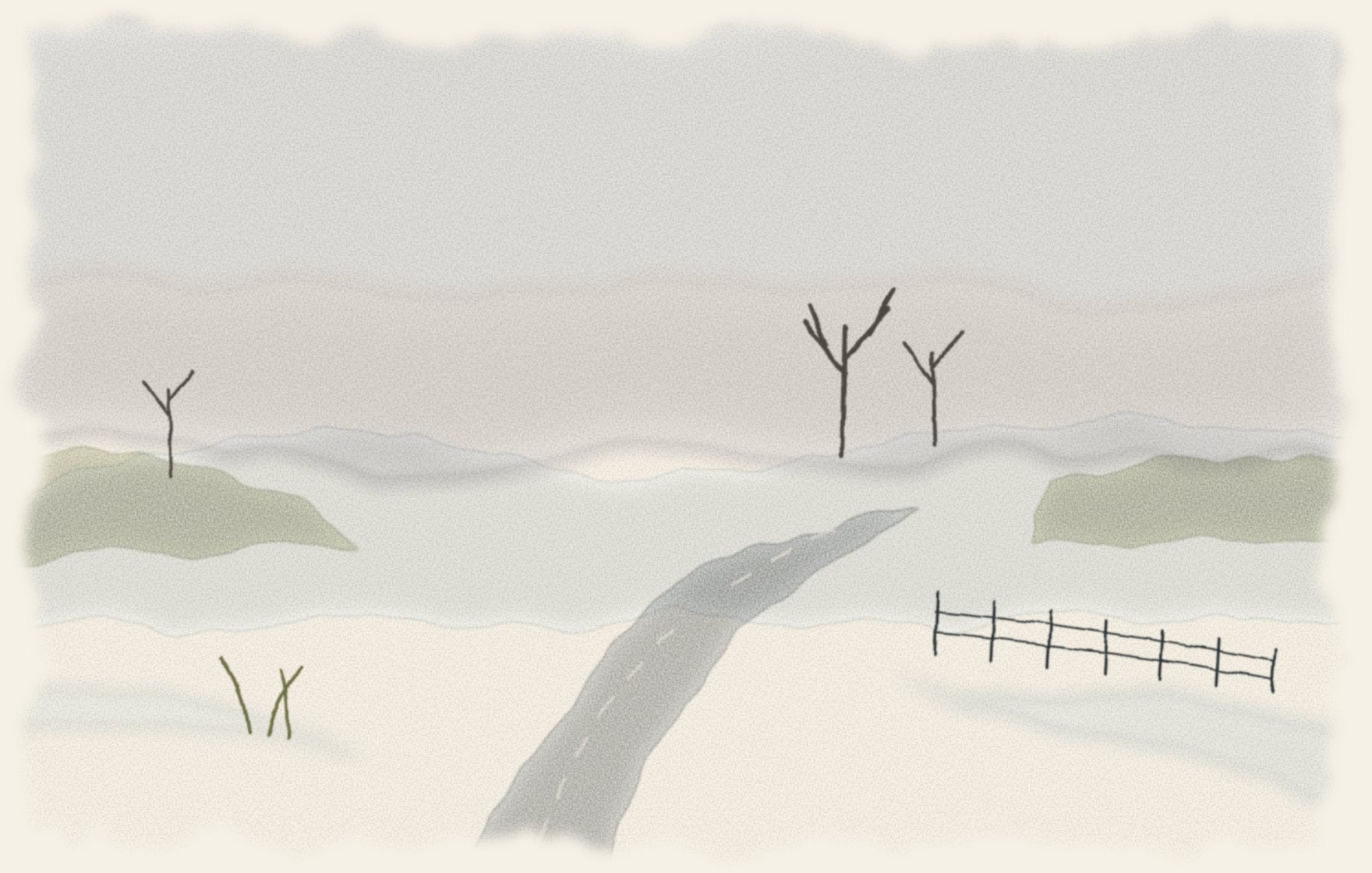
Drive inland in February and the summer country resolves into what it is underneath. Away from the lake the land is farms and orchards, the fruit trees pruned back to their frames, the vineyards laid out on the snow in rows like ruled paper. Snow fences lean along the field edges. Lake-effect snow — the kind made when cold air crosses open water, picks up moisture and drops it on the first shore it meets — comes in off the lake in bands, so that one village is white and the next, three miles on, is merely damp. Between the villages there is sometimes nobody on the road at all.
The people you do see are the ones who live here, which in summer is easy to forget anybody does. They plow the roads and run the hardware stores, teach in the schools, go into the empty cottages to check the furnaces before the pipes can freeze. A summer town is a year-round town that most of its visitors see in one season, and February is when you can tell the two apart.
The villages keep their own hours in winter. Some of the places that are crowded in August close for the season; others stay open on shorter days, and are glad to see you. Three Oaks, inland, looks in the snow like what it is: a Midwestern farm and factory town that happens to sit a short drive from the lake. Nobody is in a hurry. In a diner, if you find one open, the talk is of the roads, the ice, and who has gone to Florida.
Some of the people here have been here much longer than the towns. In 1833, when the Potawatomi ceded their lands around the southern end of the lake in the Treaty of Chicago and most were removed west, a leader named Leopold Pokagon secured a provision that allowed his band to stay in Michigan. He bought land for them near what is now Dowagiac, and they were not removed.6 The Pokagon Band of Potawatomi is still here. Its standing with the federal government had to be fought for again in the twentieth century; an act of Congress reaffirmed it on September 21, 1994, a date the Band keeps as Sovereignty Day. The big, bright casino at the edge of New Buffalo, Four Winds, is the Band’s. It is worth knowing whose it is, and why they are still here to own it.
Carl Sandburg lived in Harbert, a few miles up the shore from New Buffalo, from 1928 to 1945 — not as a summer person but all year, in a plain house above the beach that his wife, Lilian, whom everyone called Paula, designed. The house was heated with a wood-burning stove. He worked in the attic, his typewriter set on a wooden crate, and when he needed the city he took the train into Chicago, to his desk at the Daily News.7
What he wrote in that attic, through those winters, was Abraham Lincoln: The War Years, four volumes of it, which won the Pulitzer Prize for history in 1940. Paula, meanwhile, bought a few goats in 1935 and built them into a nationally known dairy herd under the name Chikaming, after the township. The family left for North Carolina in 1945. The state’s historical marker in Harbert quotes Sandburg telling a local paper, “I’ve traveled from coast to coast … and I find Harbert best of all.”7
It is the winter part we think about. The man who wrote “Hog Butcher for the World” chose to do the biggest work of his life a train ride from the city, in the months when the lake was grey and the roads were empty, in a house kept warm by a stove. It is not a bad argument for February.
Warren Woods, inland near Three Oaks, is the other place we go. It is some two hundred acres of old-growth beech and sugar maple on the Galien River — the same river that comes out between the breakwalls at New Buffalo — with trees more than a hundred and twenty-five feet tall and five feet across. It was named a National Natural Landmark in 1967.8 In late April and early May people come for the wildflowers. In February it is famous for nothing, which is to its advantage. The trail crosses the river on a footbridge, and on a still day with snow down there may be no sound but the water under the ice at the edges.
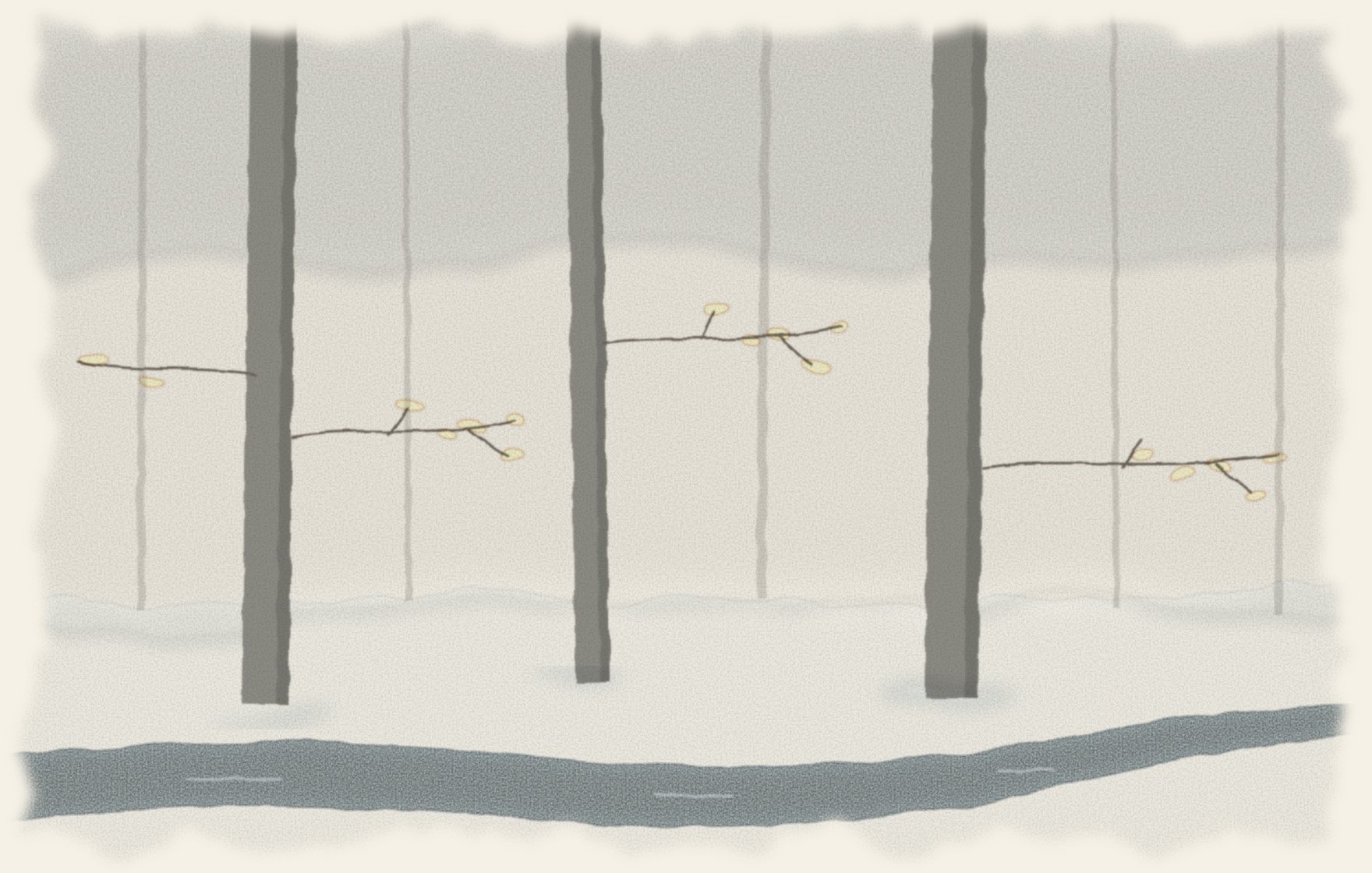
The beeches are the reason to come. Their bark is smooth and grey, like the skin of something, and in winter the young ones and the low limbs of the old ones keep their dead leaves long after every other tree has let go: pale, papery, the color of sand. Botanists call it marcescence, and they are still arguing about what it is for.9 In a light wind the understory rattles faintly, as if the woods were turning pages.
The woods exist because of the corset. In the late nineteenth century, stays for women’s clothes were made of whalebone, which was stiff, brittle and getting expensive. Edward K. Warren, a storekeeper in Three Oaks, found that the Chicago Feather Duster Company was throwing away its turkey wing quills as too stiff for dusters. He worked out how to turn them into a flexible stay, called it featherbone, and in 1883 founded the Warren Featherbone Company, which turned Three Oaks into a factory town.10 The old factory now houses a distillery.
In 1879, before any of that, Warren had bought this tract of forest, meaning to cut it for charcoal. He kept it instead.8 Later, with the featherbone money, he and his foundation bought up the duneland that became Warren Dunes. So a Chicago company’s waste feathers, by way of a Michigan storekeeper’s patent, paid for the old woods and Tower Hill both. The University of Chicago, for its part, keeps a small ecological field station beside the woods.11 The traffic across the lake has always run both ways.
The days are short, though this far west in its time zone the dark comes later by the clock than you expect, and then all at once. By seven the only lights on the shore road are porch lights and the occasional car. This is the hour February is actually for. The fire goes on; the windows turn blue, then black; the lake, which you can hear but no longer see, keeps up its thump under the ice. Supper is something that takes a long time and asks nothing of you in the meantime. Nobody has anywhere to be.
We began by saying this is the wrong season to come, and in a practical sense it is. Plenty of places are closed or keep short hours. The water is not for swimming, and the beach is for looking. You will want boots, a proper hat and some patience with the weather, which will change its mind twice before lunch. Check the forecast for a cold week, and then go anyway if it isn’t one.
But the summer version of this coast is a place a great many people share for a few months, and the winter version is simply a place: the one the people who live here know all year, the one Sandburg chose, the one where on the right cold week the lake builds a second shore out of itself and lets you watch. It shows you that less often than it used to. Go and look at it from the beach.
Notes and sources
- NPS, Indiana Dunes National Park, Shelf Ice; Smithsonian, “Why are ice volcanoes erupting on the shores of Lake Michigan?”
- FOX 17, “Beautiful but dangerous: important ice shelf safety warnings after recent rescue,” quoting the National Park Service.
- NOAA Climate.gov, “Great Lakes ice cover most extensive since mid-1990s.”
- NOAA Great Lakes Environmental Research Laboratory, Great Lakes Ice Cover (Lake Michigan annual maximum: 93.1 percent in 2014; 12.4 percent in 2002).
- NOAA GLERL, “Q&A with NOAA scientists: causes and impacts of 2024’s historically low Great Lakes ice cover.”
- Pokagon Band of Potawatomi, Our Culture; Pokagon Band of Potawatomi Indians; Band history (Ohio State University, American Indian Studies).
- Michigan Historical Marker, Carl Sandburg in Harbert; NPS, Carl Sandburg Home, biography (PDF); NPS, Sandburg family timeline.
- Michigan DNR, Warren Woods Nature Study Area; Michigan Historical Marker, Warren Woods State Park.
- Clemson Cooperative Extension, Winter Leaf Marcescence; “Marcescence,” Ecosphere (2023).
- Warren Featherbone Company Office Building; Michigan State University, Warren Featherbone Company; Journeyman Distillery, The Featherbone factory.
- Warren Woods State Park.
Where we stay.
We spend these winter weeks in a house we keep in New Buffalo, with a fire and a two-minute walk to the lake. It is open to guests for part of each year.
Ask about dates